
Beyond Gut-Feel Management: A Practical Guide to Navigating Your Business as Financial Seasons Change—Because They Will
Growth Essentials for SME Founders & CEOs
As an entrepreneur, you live and breathe your business. You do not need a diagnostic framework to tell you when cash is tight, when your team is operating at maximum capacity or when working your existing assets harder is no longer the answer.
You often sense when something has changed - and that intuition has probably informed many important decisions in your business.
But as revenue, complexity and responsibility increase, intuition alone may not be enough to identify what has changed, why it has changed or which strategy the business now requires. This matters because ...
Business growth is not linear - it moves in Financial Seasons
Growth moves in cycles and phases—what we at Abueng Advisory ("Abueng") describe through the SME Financial Seasons Framework™.
Like weather seasons, Financial Seasons do not ask for permission to arrive, and they do not always follow a neat calendar. More importantly, they can overlap, change and repeat.
You may feel as though your business is in a Traction Season because sales are growing strongly, while your cash flow is still stuck in Survival.
You can move from Traction into Rebuilding after losing a key client—or find yourself back in a Building Season when you introduce a new product line that requires new people, systems and capabilities.
Financial Seasons are not once-off milestones. They form a pattern that repeats as your business evolves.
So here is the question I would invite you to ask yourself:
“If my revenue graph is going up, but my stress, cash pressure—and perhaps even my blood pressure—are also going up, which Financial Season am I really in?”
But before you answer that question, there is something important we need to establish…
A Financial Season is not a verdict on the success or failure of the business

A business can move between Survival, Building, Plateau, Rebuilding and Traction as its internal capabilities and external circumstances change. It may even display characteristics of more than one Financial Season at the same time.
Survival is not necessarily evidence of poor management, Plateau does not mean the business has no further potential to grow, and Rebuilding is not something to be ashamed of.
Even established and profitable businesses can move between Financial Seasons following rapid growth, the loss of a major customer, changes in the market or deliberate strategic decisions.
Equally, Traction is not a permanent destination. Each Financial Season simply describes the business’s current reality and the dominant constraint that its strategy must address.
The purpose is not to label or grade the business, but to understand what it needs now—and avoid applying a strategy suited to a different Financial Season.
And without a structured way to interpret those signals, three strategic blind spots may emerge:
Misdiagnosis - focusing on the wrong problem: When growth becomes overwhelming, the natural response may be to hire more people. But if roles, processes, systems and controls have not kept pace with the business, adding headcount may increase cost and complexity without resolving the underlying problem. The dominant constraint may be Capability—not simply the number of people available.
Distortion - allowing recent events to distort the bigger picture: A promising customer conversation may create a sense of momentum, while an unexpected tax obligation may make the business feel as though it is in crisis. Measurable indicators help distinguish a temporary event from a more fundamental shift in the business.
Misalignment - lacking a shared language: A founder’s intuition can be difficult to translate into clear priorities for the team and other key statekeholders. A framework creates a common basis for identifying the business’s dominant constraint and aligning the strategy to its current Financial Season.
If you are leading a growing SME—particularly one generating between R5 million and R25 million in annual revenue—chances are your to-do list is already longer than the time available to complete it. Clients, team, SARS deadlines, suppliers, approvals and bank meetings compete for your attention. By Friday, you may find yourself looking forward to the weekend simply to catch up on the work you could not get to during the week. In that reality, stopping to ask whether your current strategy still fits can feel like a luxury you simply cannot afford.
Yet beneath the busyness, your business may already be changing.
Margins are thinner than they were two years ago.
Cash feels tighter even though revenue is higher.
Your team is larger, but you are more involved in day‑to‑day issues than ever.
These may be signs that your business has quietly shifted into a different Financial Season—while your strategy is still dressed for the last one.
And that misalignment has a cost…
The cost of running yesterday’s strategy in today’s Financial Season

When your Financial Season changes but your strategy does not, the warning signs are often subtle at first—and then suddenly difficult to ignore.
Across founder-led SMEs, three patterns often appear:
Profitless growth: Revenue is increasing, but net profit and cash remain flat or decline. The business is getting bigger, but it is not becoming financially stronger.
Capacity overload: Sales continue to grow, but the people, systems and processes supporting that growth cannot keep pace. Service quality drops, rework increases and key employees begin to burn out.
Governance gaps: The business has changed in size or complexity, but its controls, decision-making structures and financial disciplines have not kept pace. Practices that worked at R3 million in revenue become increasingly risky at R10 million.
The common thread is not poor management or a lack of effort. It is misalignment: the business has changed, but its strategy, systems and decisions are still based on an earlier reality.
And working harder will not necessarily resolve that misalignment. Neither will pursuing more sales, cutting costs or adding people—because the right response depends on what is actually constraining the business now.
Before deciding what to do next, you need to answer three questions:
Which Financial Season best describes the business today?
What measurable indicators support that diagnosis?
What does the business need in this season—not the one it has just left?
That is the purpose of the SME Financial Seasons Framework™.
So, let us look at each Financial Season in turn: what it looks and feels like, how to recognise it in the numbers, and what the business needs to navigate it successfully.
The SME Financial Seasons Framework™
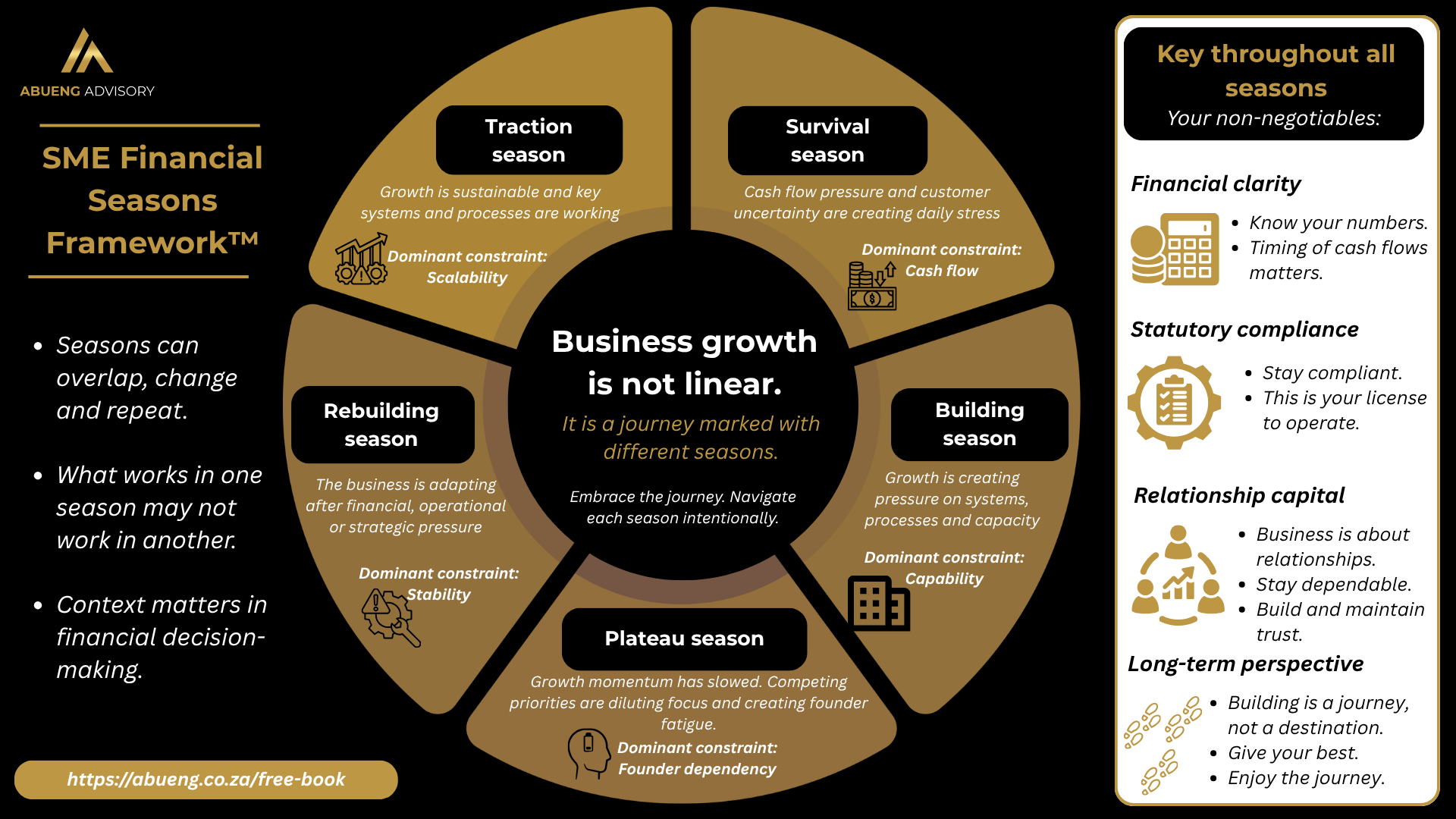
Our SME Financial Seasons Framework™ is a practical lens for understanding:
Where your business really is right now—not just in revenue terms, but in cash flow, capacity, systems and risk.
What your dominant constraint is—the primary factor limiting the business’s progress or financial sustainability more than any other.
Which strategic priorities matter most in this Season—so you stop trying to fix everything at once and focus on what will move the needle.
The seasons are not rigid boxes. They can overlap, change and repeat. However, each has a distinct dominant constraint and a different set of strategic priorities.
Season 1: Survival
Dominant constraint: Cash flow
Survival is where many SMEs begin—but it is not limited to start-ups. An established business can return to Survival after losing a major customer, experiencing a market shock or encountering sustained cash-flow pressure. You may already be generating R10 million in annual revenue and still find yourself in Survival because the cash pressure is relentless.
In this season, the immediate question is not “How do we optimise?” but “How do we stay alive?”
Typical characteristics: Irregular cash flow, late‑paying customers, owner funding payroll, heavy reliance on one or two key clients, informal processes, and the founder involved in almost every decision.
Dominant constraint: Cash flow. Cash inflows are too irregular, insufficient or poorly timed to cover the business’s immediate commitments and create breathing room.
Strategic priorities: Secure quick‑win revenue, tighten basic cash management, reduce unnecessary costs, and ensure statutory compliance is not putting you at risk with SARS or regulators.
In Survival, it is tempting to chase any money that moves. But without reliable financial information, you cannot see which customers, products or services generate cash—and which consume more than they contribute. Abueng often starts here by putting fit-for-purpose financial structures in place through reliable bookkeeping and appropriate accounts payable controls—giving the business owner a simple, honest view of the business’s cash reality.
Season 2: Building
Dominant constraint: Capability
Building is the season in which growth begins placing pressure on the people, systems and processes supporting the business.
Sales may be increasing and new opportunities arriving—but delivering the work is becoming harder. The founder is pulled into more operational decisions, employees are stretched, and processes that once worked informally can no longer carry the increased volume and complexity.
In this season, the immediate question is no longer “How do we stay alive?” but “How do we keep up without breaking what we have built?”
Typical characteristics: Growing revenue, increasing workloads, inconsistent processes, repeated errors or rework, declining service quality, unclear roles, stretched employees, and the founder remaining involved in too many day-to-day decisions.
Dominant constraint: Capability. The business has demand, but its people, systems, processes and financial infrastructure have not yet developed sufficiently to support that demand consistently.
Strategic priorities: Strengthen the capabilities required to deliver growth, clarify roles and accountability, document essential processes, introduce fit-for-purpose systems, improve management information, and decide which capabilities should be developed internally or accessed through external partners.
In Building, the instinct may be to hire more people. But additional headcount will not solve unclear roles, weak processes or unreliable financial information. It may simply increase costs while preserving the same underlying problems.
Abueng often supports businesses in this season by strengthening their financial structure and helping them develop a fit-for-purpose finance capability. For many growing SMEs, this does not require immediately building a full internal finance department. A hybrid model—combining management accountability with the right internal and outsourced support—can provide the capability the business needs for its current size, complexity and Financial Season.
Season 3: Plateau
Dominant constraint: Founder dependency
Plateau is the season in which the business is still operating—and may remain profitable—but its growth momentum has slowed. Revenue may have levelled off, margins may be under pressure, and competing priorities are making it difficult to identify what should happen next.
The founder is often still central to customer relationships, approvals, problem-solving and key decisions. The business has grown, but too much of its knowledge, authority and momentum still sits with one person.
In this season, the immediate question is no longer “How do we keep up?” but “Why are we working this hard without moving forward?”
Typical characteristics: Flat or inconsistent revenue, declining margins, founder fatigue, delayed decisions, too many competing priorities, limited management accountability, dependence on a few key customers, and growth initiatives that repeatedly lose momentum.
Dominant constraint: Founder dependency. The business cannot progress consistently without the founder’s direct involvement, but the founder no longer has the capacity to remain at the centre of every decision, relationship and operational issue.
Strategic priorities: Reassess the route to market, strengthen customer understanding, clarify the brand’s positioning, improve operational accountability, restore financial discipline, and develop leadership capacity beyond the founder.
Plateau is not evidence that the business has reached its full potential. It is often a signal that the strategy and leadership model that created earlier growth can no longer create the next stage of growth on their own.
Abueng often supports businesses in this season by helping the founder step back from the noise and identify where momentum has been lost. Through structured diagnostics, strategy facilitation and business coaching, the focus shifts from pursuing every possible initiative to selecting the few priorities that can reduce founder dependency and move the business forward again.
Season 4: Rebuilding
Dominant constraint: Stability
Rebuilding is the season in which the business is adapting after financial, operational or strategic pressure. It may follow the loss of a major customer, rapid growth that exposed weak foundations, a change in leadership, declining margins, a market disruption or a deliberate decision to change direction.
The business may still have customers, capable employees and valuable assets—but parts of the operating model are no longer working as they should. Some activities need to be repaired, others redesigned, and some stopped altogether.
In this season, the immediate question is no longer “Why are we not moving forward?” but “What must we stabilise before we can move forward again?”
Typical characteristics: Unstable margins or cash flow, organisational changes, inconsistent delivery, declining customer confidence, duplicated or outdated processes, restructuring, leadership uncertainty, and difficult decisions about what the business should retain, change or discontinue.
Dominant constraint: Stability. The business is undergoing change, but its financial position, operating model, leadership structures or customer base are not yet stable enough to support confident forward movement.
Strategic priorities: Restore financial visibility, protect cash, stabilise customer and supplier relationships, clarify the future operating model, address underperforming activities, strengthen governance and controls, and sequence changes so that the business is not destabilised further.
Rebuilding is not something to be ashamed of. Sometimes the most responsible strategic decision is to pause, repair what is no longer working and rebuild the business on stronger foundations.
Abueng often supports businesses in this season by helping management establish a reliable financial baseline, identify where value is being lost and prioritise the changes that will create stability. The objective is not to recreate the business as it was, but to build the structure, financial discipline and strategic clarity required for what it needs to become.
Season 5: Traction
Dominant constraint: Scalability
Traction is the season in which growth is sustainable and the business’s key systems and processes are working. Demand is more predictable, customers are returning, financial performance is improving and the business is less dependent on the founder for every operational decision.
But Traction introduces a different challenge. What works at the current scale may not continue working as transaction volumes, employee numbers, customer expectations and financial exposure increase.
In this season, the immediate question is no longer “What must we stabilise?” but “How do we grow without losing control?”
Typical characteristics: Consistent revenue growth, improving cash generation, repeat customers, clearer roles, more reliable systems, stronger management capability, increased market credibility, and growing opportunities to expand into new products, customers or markets.
Dominant constraint: Scalability. The business has a model that works, but its people, systems, controls and leadership structures must be able to support further growth without service quality, margins or financial discipline deteriorating.
Strategic priorities: Protect margins and cash generation, strengthen governance and risk management, develop leadership capacity, automate or standardise repeatable processes, allocate capital carefully, test expansion opportunities and ensure that growth does not outpace the business’s financial and operational infrastructure.
Traction is not permission to pursue every opportunity. Growth can still destroy value when the business expands faster than its capacity, controls or cash resources can support.
Abueng often supports businesses in this season by strengthening financial governance, improving management reporting and helping leadership evaluate growth opportunities against their likely financial return, implementation effort and capacity requirements. The objective is not growth at any cost, but growth that strengthens the business’s long-term financial sustainability.
And Traction is not a permanent destination. A major customer loss, an unsuccessful expansion, rapid unmanaged growth or a change in market conditions can move the business into another Financial Season. The discipline is therefore not simply to reach Traction, but to keep reading the signals and adapting the strategy as the business changes.
Your next steps: Identify your Financial Season and navigate it intentionally
Gain clarity and prioritse for your season :
We invite you to download our complimentary book, The SME Financial Seasons Framework™. It expands on each season in more detail and shares practical strategies we use with SMEs to align their strategy, finances and operations with their current Financial Season.
Before your next big decision—whether it involves hiring, expansion, funding or a new product—pause and complete the SME Financial Seasons Diagnostic™. Make that decision with the clarity and confidence that come from understanding which Financial Season is dominant in your business right now.
Financial Seasons will change. They may overlap. They may repeat. You cannot prevent every shift—but with the right framework and support, you can recognise the signals, respond intentionally and build a business that is stronger, more resilient and financially sustainable.
Abueng Advisory - SME Accounting Firm: Business growth is not linear. We help SMEs navigate different financial seasons with clarity and confidence. Explore our services and pricing to determine the right level of support for your business.