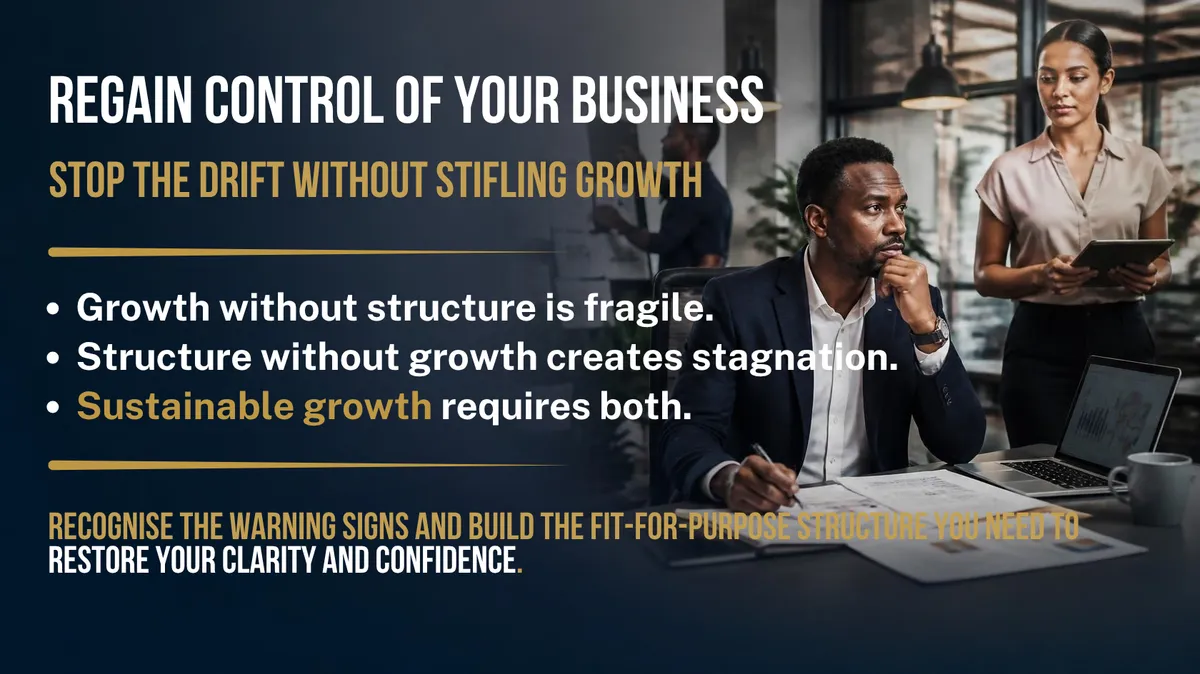
Worried your SME is drifting out of control? 12 warning signs you should not ignore
Leadership Essentials for Founder-led SMEs
Feeling like your business is slipping through your fingers does not always mean you are in crisis. Often, it means you no longer have the visibility, reliable information and clear accountability needed to lead with confidence.
These gaps can emerge as transactions, commitments, decisions and exceptions accumulate - even when revenue or headcount has not changed dramatically. They may be signs that parts of your Financial Governance and wider business structure need to be reconsidered.
That “out of control” Feeling: What’s really going on?
Let’s start with an honest question:
When last did you feel fully in control of your business?
Not busy. Not firefighting. Not hoping all is okay. In control.
Many founders describe a business that is still functioning - but no longer feels fully under control.
Clients are being served. Employees are working. Yet too many questions, decisions and unresolved matters continue returning to the founder.
You cannot always see clearly. You do not fully trust the numbers. Work keeps getting stuck in the same places. And you may find yourself quietly asking:
“Is this business getting away from me?”
Feeling out of control does not necessarily mean your business is failing.
It may mean that its structure, processes and controls no longer provide the visibility and accountability you need.
📌 Key takeaway: “Out of control” in an SME is usually less about dramatic chaos and more about gaps that have accumulated in its structure, visibility and Financial Governance.
How “out of control” typically shows up in an SME
In a larger organisation, weaknesses may be surfaced through formal reporting, exco meetings, internal audits or board oversight.
In an SME, the founder often feels the loss of control before it appears in a formal report. It shows up through recurring surprises, repeated mistakes, last-minute cash pressure, unresolved operational issues and information that you do not quite trust.
Financial Governance does not mean introducing disproportionate corporate-style structures. It means introducing a fit-for-purpose structure that gives the business three essential foundations:
Visibility: You can see what is happening early enough to respond. This includes cashflow, operational and risk visibility.
Reliable information: Your financial information, operational data and lived experience sing in harmony to tell the same story - so you can understand what is really happening and make decisions with confidence.
Clear accountability: People understand what they own, which decisions they can make, how their performance is assessed, and when and how issues should be escalated.
When these foundations are present, they produce something every founder needs:
Clarity and confidence: You can rely on your information, processes, controls, strategies and team without personally monitoring every activity—giving you the confidence and capacity to build a financially sustainable business.
📌 Key takeaway: Control in an SME is not about micromanaging people. It is about creating structures that support the team, enable better decisions, establish clearer accountability and reduce avoidable surprises.
12 warning signs your business may be drifting out of control
Let’s walk through 12 observable warning signs.
⏹️As you read, ask yourself: “Is this us? How often does this happen?”
These signs cut across sales, operations, finance and human resources - because a business cannot be brought under control through finance alone.
1. Unresolved accounts that never seem to close
Do you have old supplier balances, customer credits or suspense accounts that have been “waiting to be sorted” for months?
This is more than an administrative irritation. It may indicate weaknesses in your reconciliation and review controls—and raise questions about whether your balance sheet reflects reality.
⏹️ Reflective question: “If my fellow director, auditor, lender, potential investor or SARS walked in tomorrow, would I be comfortable explaining every major line item on my income statement and balance sheet?”
2. Unreliable reports you do not fully trust
You receive management accounts or sales reports but immediately question them. The numbers change after the meeting without explanation, and no one can clearly explain why the cash position feels disconnected from the reported profit.
This erodes your confidence, and you may find yourself relying on gut feel instead of reliable financial information.
⏹️ Reflective question: “Which numbers in my business can I not confidently rely on today?”
3. Recurring operational issues that keep coming back
The same delivery delays. The same invoicing errors. The same customer complaints.
You hold meetings, send emails and give warnings - but the pattern returns.
When an issue persists despite repeated intervention, the problem may extend beyond individual performance.
Your structure, systems and processes may not be supporting the outcomes you want.
⏹️ Reflective question: “Which three issues have we been discussing over and over without the situation improving?”
4. Constant cash surprises despite “being profitable”
You show a profit on paper but still find yourself delaying payments, negotiating for more time or discovering commitments later than you should.
Without forward-looking cashflow visibility, the business can feel as though it is living from month to month.
This may indicate that cash commitments, expected inflows and timing differences are not being brought together in one reliable view.
⏹️ Reflective question: “Can I see our expected cash position three months from now with reasonable confidence?”
5. Too many deliverables still depend on your direct involvement
Founder involvement is often one of the reasons an SME succeeds. Your standards, relationships and knowledge help the business deliver - particularly while it is still small.
As activity and complexity increase, however, the way the business depends on you must evolve. The objective is not to remove you from the business or hand over everything at once. It is to progressively reduce founder dependency through "proportionate letting go".
This means enabling capable people to take end-to-end ownership of appropriate deliverables, supported by clear expectations, practical processes, decision rights and escalation paths.
If routine work repeatedly stalls until you follow up, review it or step in to complete it, the structure around you may not yet be carrying its appropriate share of the load.
⏹️ Reflective question: “Which recurring deliverables could someone else own from beginning to end—with clear standards, appropriate authority and agreed check-in points?”
6. Roles are blurry and accountability is unclear
When something goes wrong, you hear:
“We thought they were handling it.”
“No one told me.”
This may indicate that your structure lacks clear roles and accountability.
People cannot consistently own outcomes if they do not know where their responsibilities begin and end. One useful tool for creating this clarity is the RASCI matrix:
R | Responsible | Who performs the work? Can be more than one person. |
A | Accountable | Who ultimately owns the outcome? There should be one clearly identified person. |
S | Support | Who helps to complete the work? |
C | Consulted | Who must be consulted before action is taken? |
I | Informed | Who must be kept updated? |
More than one person may contribute to the work, but there should be one clearly identified person who is accountable for the outcome.
⏹️ Reflective question: “For each core project, deliverable or process, is it clear who holds the "A" - the person ultimately accountable for the outcome?”
7. Processes live in people’s heads, not in shared systems
If your “process” is “Ask Thabo; he knows how to do it,” you do not yet have a dependable process. You have a business continuity risk.
When that person is on leave, becomes ill or resigns, the business feels it immediately. This also makes training and consistent delivery more difficult than they need to be.
This does not mean documenting every activity in a lengthy manual.
It means capturing enough practical guidance for another capable person to perform the work reliably.
⏹️ Reflective question:“Could a capable new employee follow our key processes using the available guidance and reasonable support?”
8. There is no consistent rhythm of reporting and review
Some months you review the numbers. Some months you do not.
There is no consistent weekly, monthly or quarterly reporting rhythm in which you step back, assess performance and make decisions.
Without that cadence, problems can grow quietly in the background until they become urgent.
⏹️ Reflective question: “Do we have a fixed calendar for financial and operational reviews - and do we follow it?”
9. Controls exist on paper but not in practice
You may have a finance policy or a Delegation of Authority ("DOA") document, but
invoices are still paid without appropriate approval.
stock leaves the warehouse without required documentation.
exceptions gradually become the normal way of working.
These gaps in financial and operational controls can expose the business to errors, fraud and costly decisions.
⏹️ Reflective question: “Where are we relying on memory or goodwill when a simple, practical control is needed?”
10.Your technology has grown faster than the discipline around It
You have introduced cloud accounting, a CRM system or a project-management tool -but the systems are not consistently used as intended.
Information is captured more than once. Reports do not agree. Employees develop their own workarounds.
This does not necessarily mean that your SME needs an expensive, fully integrated system or ERP. Separate tools can remain fit for purpose if the flow of information between them is clearly defined, regularly reconciled and properly owned.
The issue may not be the tools themselves.
It may be the absence of appropriate training, clear ownership, disciplined processes and practical, documented procedures.
⏹️ Reflective question: “Are we using each system consistently and for its intended purpose - or are our tools creating duplication, confusion and unnecessary work?”
11. Key people are overwhelmed, but you are not sure why
Your operations manager, finance lead or sales head appears consistently stretched, yet important deliverables are still delayed or falling through the cracks.
This may point to a mismatch between the role and the capabilities, capacity or support required by the business today.
The business may have outgrown the original job description, while the role and its supporting structure have remained unchanged.
⏹️ Reflective question: “Do our current roles, capabilities and capacity still match what the business requires today?”
12. You find yourself postponing a closer look at the numbers
This warning sign is subtle but powerful.
You delay reviewing the management accounts.
You skim over cashflow reports.
You postpone asking questions because you are concerned about what you may discover - or whether the information is sufficiently reliable to give you a clear answer.
This avoidance may itself be a warning sign that your Financial Governance and reporting structures require attention.
⏹️ Reflective question: “What questions about the business might I be postponing because I do not fully trust the numbers - or because I am concerned about what they may reveal?”

Regaining control without becoming a micromanager
Many founders resist the idea of “more controls” because:
they don't know what type of controls would be appropriate for their business;
they don't know how to regain control without the team feeling micromanaged; and
they don't want to lose the agility and entrepreneurial spirit that built the business in the first place.
Those concerns are valid—and can be addressed. Regaining control is not about personally monitoring every detail.
It is about designing proportionate, effective structures that:
Give you the visibility and reliable financial information you need to make timely, confident decisions.
Empower your team through clear roles, simple processes and practical controls—so they can do their best work without constant supervision.
Free you to focus on high-value work: strategy, relationships and growth - instead of chasing invoices or repeatedly checking reports.
📌 Key takeaway: The right SME business controls are not designed to slow you down. They remove friction, reduce noise and help protect the business you have worked so hard to build.
Warning signs are signals, not proof of failure
If you recognised your business in several of these warning signs, you are not alone.
At Abueng Advisory, we help SMEs strengthen their Financial Governance through fit-for-purpose structures aligned with the business’s current Financial Season.
We combine Growth AND Financial Governance strategies so that control and growth support each other - not work against each other.
📌 Key takeaway: Clarity and control are not luxuries reserved for large corporates. They are foundations for building a financially sustainable business.
Take the next step: understand your Financial Season
Every SME operates within a Financial Season:
Survival
Building
Plateau
Rebuilding
Traction
These seasons can overlap, change and repeat because business growth is not linear.
The structures, controls, capabilities and support your business needs may therefore change from one season to another.
Trying to run today’s business with structures designed for an earlier Financial Season can contribute to that “out of control” feeling.
To help you identify where your business is now - and what may require attention next - we created a practical guide: The SME Financial Seasons Framework™.
It was written specifically for South African SMEs and draws on our experience supporting Founder-led and Board-led businesses.
📌 Use the book as a structured way to reflect on your current warning signs and identify Growth AND Financial Governance strategies that may help you address them—without losing the entrepreneurial energy that brought you this far.
Abueng Advisory - SME Accounting Firm: Business growth is not linear. We combine fit-for-purpose Growth AND Financial Governance strategies to help SMEs navigate different financial seasons with clarity and confidence. Explore our services and pricing to determine the right level of support for your business.